REVIEW · BOLOGNA
Bologna: Historical Highlights Walking Tour with Local Guide
Book on GetYourGuide →Operated by Walks In Europe · Bookable on GetYourGuide
Neptune is your starting gun. In this 2.5-hour, max-8-person walk, you’ll connect Bologna’s biggest sights—San Petronio, the Two Towers, porticoes, and more—with a real local’s explanations in English.
I especially like the small-group pace (so questions don’t get lost) and the chance to spend time where history is carved into stone, not just read off a sign.
I also like that the tour includes interior time in major churches—San Petronio Basilica and Santo Stefano—so you get the atmosphere, not only the exterior photos. One thing to consider: the timing is strict. You need to show up 15 minutes early, because entry is timed and tickets can expire soon after the start, and you can’t join once the tour begins.
In This Review
- Key highlights worth your attention
- Neptune to Piazza Maggiore: start where Bologna makes sense
- San Petronio Basilica: Gothic drama meets scientific curiosity
- Archiginnasio of Bologna: the University’s fingerprints on the city
- Porticoes and squares: why Bologna walks like this
- Le Due Torri (Two Towers): read the skyline like a story
- Santo Stefano: seven churches, one peaceful maze
- What the 2.5-hour timing really means on your feet
- Price and value: what $55.80 buys you here
- Guides you might meet: English that lands, stories that stick
- Who should book (and who should skip this one)
- Final call: should you book this Bologna walking tour?
- FAQ
- How long is the Bologna Historical Highlights Walking Tour?
- What group size is this tour?
- Where do I meet the guide?
- What sites does the tour include inside and outside?
- Do I get to climb the Two Towers?
- Is the tour in English?
- Do I need to arrive early?
- Are there any limits on what I can bring?
- Is the Archiginnasio courtyard visit available on Sundays?
- What if a site is closed for holy observances?
Key highlights worth your attention
- Piazza del Nettuno meetup right in the historic center, near Bar Vittorio Emanuele
- Neptune’s Fountain as the orientation point before you head into Piazza Maggiore
- San Petronio interiors with chapels, artwork, and the Meridian Line
- Archiginnasio visit tied to the University of Bologna’s old-world influence
- Santo Stefano interiors including a complex of interconnected chapels
- Two Towers only from outside, since climbing isn’t included
Neptune to Piazza Maggiore: start where Bologna makes sense
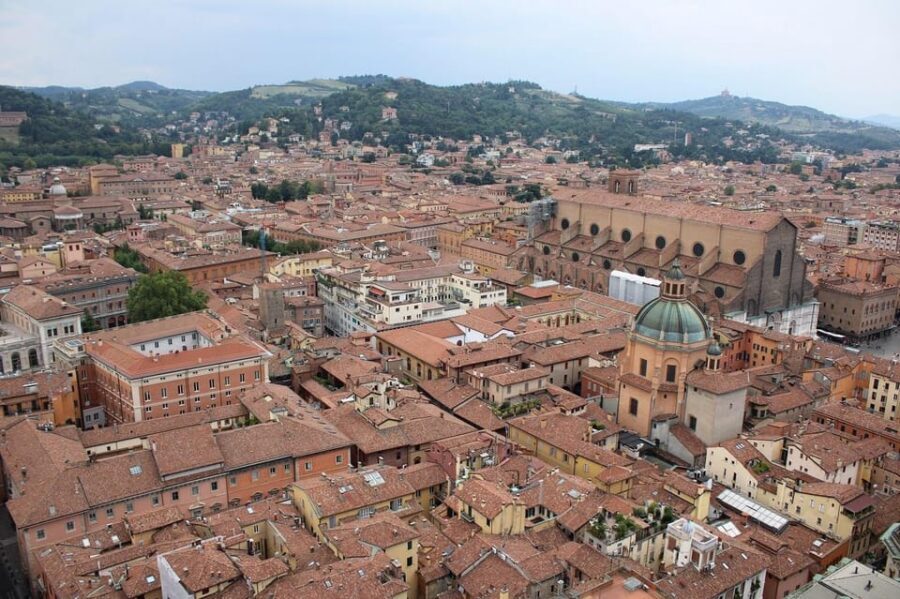
The tour begins at Piazza del Nettuno, in front of the Neptune statue, close to Bar Vittorio Emanuele. Meeting here is smart: Bologna’s sights aren’t spread out in a scary way, and you get a clear visual anchor right away. The guide will be holding a signboard for Walks In Europe, so you can find the group quickly.
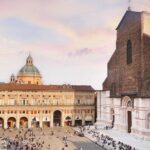
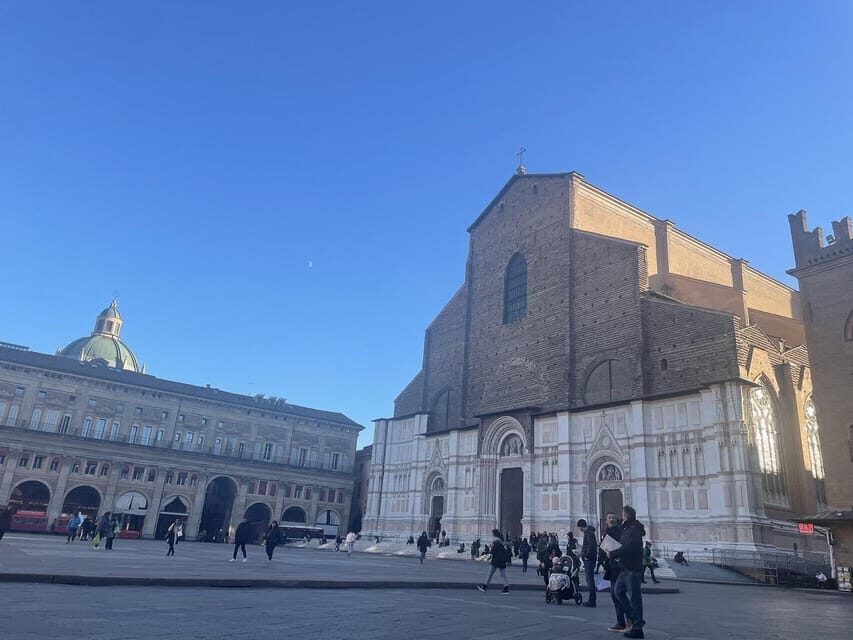
From that first stop, you’ll head toward the heart of the city—Piazza Maggiore. This is where the architecture starts speaking: palaces, civic buildings, and the big church presence that defines the skyline. Your guide’s job is to help you read what you’re seeing, including how these places worked for people over centuries, not just why they look impressive in photos.
If you like walking tours that feel organized (and not like a friendly wander), this one usually delivers. The group size stays small, and the flow between stops is built for a 2.5-hour window.
Other local guide experiences in Bologna



San Petronio Basilica: Gothic drama meets scientific curiosity
San Petronio is the tour’s main church moment, and it’s a big deal. You don’t just pass by; you go inside for a guided visit. The scale alone can make you feel small—in a good way.
What I like here is the mix of styles and details. You’ll spend time looking at chapels, sculptures, frescoes, and the kind of visual density that makes a guide worth the ticket price. You’ll also hear about the Meridian Line, tied to Bologna’s scientific legacy. It’s one of those features that can sound abstract until someone explains why it matters in the real city story.
Practical tip: this is still a functioning sacred space. Dress respectfully, and keep your pace steady. If you’re used to blasting through churches in 20 minutes, plan for a slower look here—you’ll get more from it.
Archiginnasio of Bologna: the University’s fingerprints on the city
Next comes the Archiginnasio of Bologna, once the main building of the University of Bologna. This is where you’ll get a different side of the city: Bologna as a school town, where ideas pulled people in and shaped the streets.
During the guided visit, you’ll spend time around the inner courtyard, which features coats of arms. Those symbols aren’t just decoration. They hint at the people connected to the university and the social importance of studying here long before the world was wired the way it is today.
One important day-of-week note: the inner courtyard isn’t available on Sundays. If you’re planning a Sunday visit, expect the guide to adjust the experience accordingly.
Porticoes and squares: why Bologna walks like this
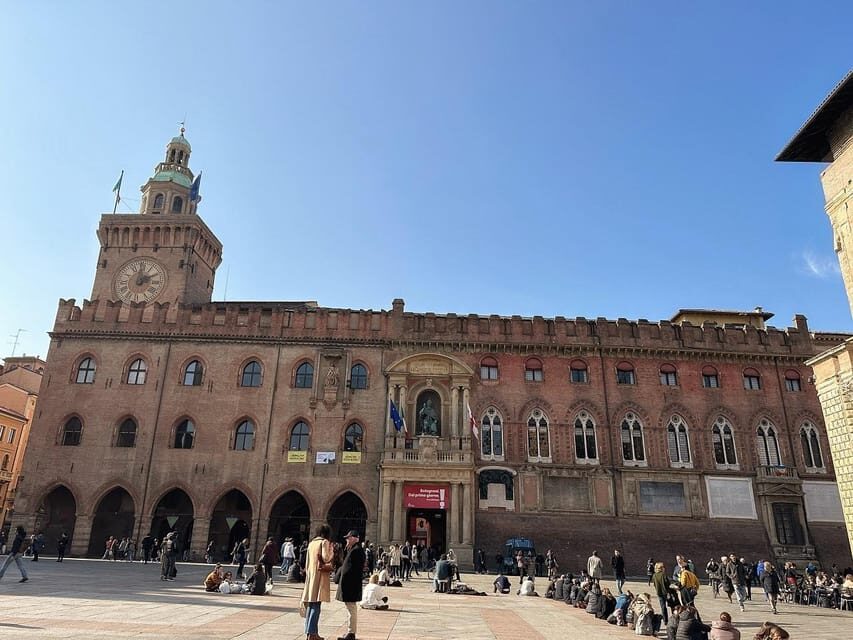
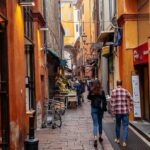
Bologna’s porticoes are not a single attraction. They’re the city’s everyday design choice made permanent. On this walk, you’ll pass through the historic streets and see the network of porticoes, those long covered walkways that stretch for kilometers.
Your guide will help you understand the practical purpose: protection from weather, plus a covered place for commerce and daily movement. So when you look up at repeated arches and think, This is pretty, the next thought should be, This is functional. That’s the local angle that makes the walk feel real.
You’ll also get time on the picturesque squares and around classic buildings. The goal isn’t to list every facade for the sake of it. It’s to show you how the city’s layout supports life: where people gathered, where they walked, and how the architecture grew around those habits.
Le Due Torri (Two Towers): read the skyline like a story
Then you’ll reach the Two Towers—Asinelli and Garisenda—one of Bologna’s signature medieval landmarks. Here’s the expectation to set: you’ll see them from outside, not climb them. If climbing is your priority, you’d need a different activity for that.
Still, seeing the towers from the street is useful because it puts them in context. The towers used to be part of a wider competition between families, and your guide will connect that idea to what you see today. Even without climbing, you can get the feeling of how vertical status once worked in this city.
This is also a good moment for photos. And if you’re prone to turning everything into a comparison game, stop yourself for a second. These towers aren’t just tall. They’re a clue to how Bologna organized power.
Other historic centre and hidden gems tours in Bologna

Santo Stefano: seven churches, one peaceful maze
The tour ends with Basilica di Santo Stefano, often called the Seven Churches. It’s a complex of interconnected chapels, so the experience feels less like one big church and more like a series of connected spiritual rooms.
The guide brings you through the interior with a focus on the architecture and atmosphere: corridors that feel labyrinthine, plus quiet courtyards that slow your steps down. This stop is a nice contrast after the big, dramatic statement of San Petronio and the bustle of central squares.
If you like places where you can feel the layout in your legs—turn, pause, turn again—Santo Stefano is a strong finish. It’s also a good place to take a breath before you head back out on your own.
What the 2.5-hour timing really means on your feet
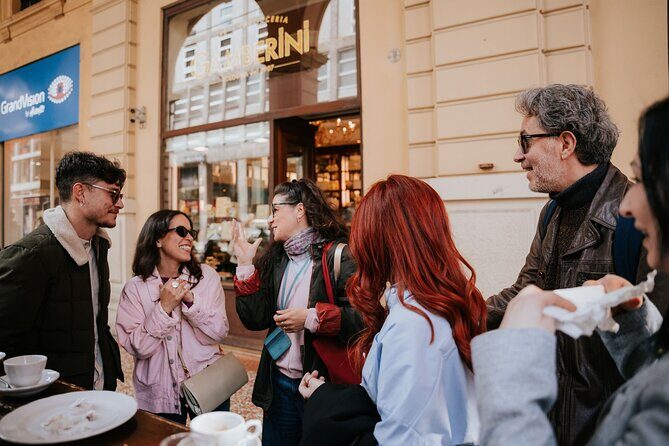
This is a 2.5-hour small-group walk, with a group size of up to 8 people. That matters because it keeps the pace human. You’re not stuck in a long line behind a dozen other camera-ready bodies, and you’re more likely to get your specific questions answered.
The route works on a typical walking-tour schedule: orientation at Neptune, major sights in the city center, and interiors timed so you don’t feel like you’re rushing every threshold. Still, it’s not a sit-down museum tour. You’ll be walking.
Also keep in mind the strict entry timing. You’re asked to arrive at the meeting point 15 minutes early due to timed tickets, and tickets expire within 5 to 10 minutes. It’s not possible to join once the tour has started, so don’t gamble on being late.
If you’re traveling with kids, the walking time may be fine for older teens, but the sacred-site dress expectations and timing rules are still something to consider.
Price and value: what $55.80 buys you here
At $55.80 per person for a 2.5-hour guided walk, the best value angle is the mix of pay-for-your-time experiences. You’re paying for more than seeing landmarks: you’re getting guided time inside two major sites—San Petronio and Santo Stefano—plus a guided stop at Archiginnasio, with the Two Towers covered from the outside.
You’re also getting help that usually costs time on your own: a skip-the-ticket-line approach and the structure that keeps you moving between spots efficiently. For a city like Bologna, where getting into interiors can take planning, that value adds up fast.
On the flip side, you should know what’s not included: Two Towers climbing isn’t part of the package. If you’re hoping to go up, you’ll need to plan for that separately.
Guides you might meet: English that lands, stories that stick
This is one of those tours where the guide really shapes the whole experience. The English quality matters, because the city’s details are the point.
You might meet Maurizio, who is noted for command of the Bologna story and for impressive English with lots of examples and anecdotes. Or you might meet Vittoria, described as engaging, clear, and willing to answer questions in a detailed way. Either way, the common theme is a guide who treats the walk like a living city lesson, not a list of facts.
That’s where you feel the difference between reading a guidebook and having someone point out what to notice. You’re not only looking at stone; you’re learning how to connect it to why Bologna feels the way it does.
Who should book (and who should skip this one)
This tour is a strong fit if you want a focused highlights route without doing the planning math yourself. It’s especially good for people who:
- want interior access at major churches
- prefer a small-group pace
- like explanations about architecture and city layout, not just photo stops
- can handle walking in historic-center terrain for about 2.5 hours
There are also clear limits. It’s not suitable for pregnant women, people with mobility impairments, or people with pre-existing medical conditions. If any of those apply, it’s worth choosing a gentler alternative.
Also, there are practical rules: no weapons or sharp objects, and no luggage or large bags. If you travel light, you’ll have a smoother time.
Final call: should you book this Bologna walking tour?
Yes, if you want a guided path through Bologna’s top landmarks with real time inside San Petronio and Santo Stefano, plus the context that makes porticoes and squares feel like part of one story. The small group size keeps it enjoyable, and the focus on interior sites makes the price feel more grounded than a basic stop-and-snap tour.
I’d skip it or adjust plans if you can’t meet the strict timing, need accessibility-friendly pacing, or you specifically want to climb the Two Towers. Otherwise, this is a very workable way to get your bearings and start understanding Bologna in a couple of hours.
FAQ
How long is the Bologna Historical Highlights Walking Tour?
It lasts about 2.5 hours.
What group size is this tour?
It’s a small-group tour with a maximum of 8 people.
Where do I meet the guide?
You meet in front of the Neptune statue at Piazza del Nettuno, near Bar Vittorio Emanuele. The guide has a signboard for Walks In Europe.
What sites does the tour include inside and outside?
You’ll have interior visits at Santo Stefano and San Petronio Basilica, an exterior visit of the Two Towers, and a visit to Archiginnasio of Bologna.
Do I get to climb the Two Towers?
No. The Two Towers climb is not included.
Is the tour in English?
Yes, the live guide speaks English.
Do I need to arrive early?
Yes. You must arrive 15 minutes before the start due to timed entry, and tickets can expire within 5 to 10 minutes. You can’t join after the tour has commenced.
Are there any limits on what I can bring?
Yes. Weapons or sharp objects are not allowed, and luggage or large bags are not allowed.
Is the Archiginnasio courtyard visit available on Sundays?
No. The inner courtyard of Archiginnasio is not available for visits on Sundays.
What if a site is closed for holy observances?
In case of occasional closures, your guide will explain from outside the sites. For last-minute closures, modifications may be communicated at the tour start time.