REVIEW · BOLOGNA
Bologna Murder Mystery: Self-Guided City Quest
Book on Viator →Operated by Questo · Bookable on Viator
Bologna, but make it a mystery. This self-guided, app-based city quest turns major landmarks into puzzle clues, so you’re not just sightseeing—you’re hunting answers. I like that it works without an internet connection, and that you can pause and resume when you need a coffee break. One heads-up: the story framework is fun, but the logic of the mystery may not click perfectly for everyone.
If you enjoy walking a city with a light hand guiding you, this is a nice fit. You choose when to start and when to finish, and the route covers a very Bologna mix: church art, the Two Towers area, university-era sites, and Piazza Maggiore. For a small price, you’re paying for the app puzzles and the storyline, not for a human escort.
You’ll start at P.za XX Settembre, 15 and end at P.za Rossini, 1, and the app provides step-by-step directions to help you get to Piazza Rossini. If your idea of a tour means lots of sitting and a live guide explaining every detail, this won’t be that kind of experience.
In This Review
- Key things to know before you play
- Bologna at your pace: the app-guided murder mystery vibe
- Price and timing: fitting one hour of clues into your day
- Porta Galliera: ornate gateway clues at the edge of the old walls
- Piazza VIII Agosto: market-side puzzle hunting
- Arena del Sole: theatre history in an “1810 roots, 1995 revival” stop
- Fountain of Neptune: bronze details and Renaissance design hints
- Oratory built in the late 1400s: looking under the surface
- Piazza Maggiore and San Petronio: the unfinished facade puzzle
- Baroque church with Sorrow over Dead Christ: art you can’t ignore
- Two leaning towers: Asinelli and Garisenda challenges
- University of Bologna area: classes once held anywhere
- Montagnola Park, Cathedral area, and a slower walk rhythm
- Archiginnasio and Palazzo dei Banchi: learning in buildings and facades
- How to make the quest feel easy (instead of stressful)
- Should you book the Bologna Murder Mystery quest?
- FAQ
- How long is the Bologna Murder Mystery self-guided city quest?
- What does it cost?
- Do I need an internet connection to play?
- Is it available in English?
- Can I start and stop whenever I want?
- What’s included with the booking?
- Where do I meet, and where does it end?
- Is there a physical tour guide with you?
- Can I cancel for free?
Key things to know before you play
- Offline-friendly gameplay means no data worry while you’re walking.
- Pick your start and stop time for an easy fit into a busy day.
- 11 puzzle challenges keep you looking closely at places you might otherwise miss.
- A story-driven route connects landmarks through real-world clue hunting.
- Private by group: your group only, no mixing with strangers.
- English available so you can follow the clues without translation stress.
Bologna at your pace: the app-guided murder mystery vibe
This isn’t a guided walking tour where you follow one narrator and listen while traffic and crowds shuffle everyone along. It’s a self-guided “murder mystery” style quest built around clues you find on-site, answered through an app.
That structure matters. Instead of reading a plaque and moving on, you slow down on purpose. You’re looking for specific details—then using those details to unlock the next step. If you like travel that feels like a game (not a lecture), you’ll enjoy the format.
The experience runs in English and is designed to work with mobile access code delivery. It also has flexibility built in: you can pause and resume, which is great for real-life travel. People eat, people get distracted by gelato, and sometimes you simply need to step back from the crowd for a minute.
Other self-guided audio tours in Bologna

Price and timing: fitting one hour of clues into your day
At $6 per person for an approximately 1 hour experience, you’re buying something straightforward: a timed walking loop with puzzle stops and a storyline. You’re not paying for museum tickets or for a human guide, since there’s no physical guide included.
One practical advantage of the setup is the schedule flexibility. The opening hours run Monday through Sunday from 12:00 AM to 11:59 PM, which makes it easier to squeeze into early mornings or late afternoons. And since you can choose your beginning and end time, you’re not locked into one departure clock the way you are with many organized tours.
It’s also described as a private tour/activity, so it’s only your group following the app. If you’re traveling with family or friends, that can be a real comfort: fewer people to coordinate, and less pressure to keep pace.
Porta Galliera: ornate gateway clues at the edge of the old walls
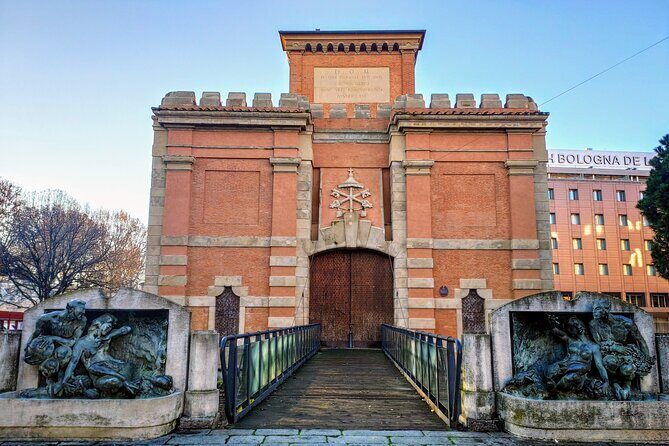
Your first puzzle stop is Porta Galliera, one of the remaining medieval outer city gates. It’s the most ornamented of the gates still standing, and it was built between 1659 and 1661 based on designs by Bartolomeo Provaglia.
This is a great “start” because it immediately sets the tone: you’re not starting at the biggest icon first. You’re learning how Bologna looked when it still had outer walls—and then you’re asked to look around to find the answer that moves you forward. That means you’ll notice craftsmanship rather than just passing by.
If you’re the type who enjoys observing stonework and details, this first stop is a win. If you’re expecting a dramatic show, it’s more about looking closely and reading the architectural clues with your own eyes.
Piazza VIII Agosto: market-side puzzle hunting
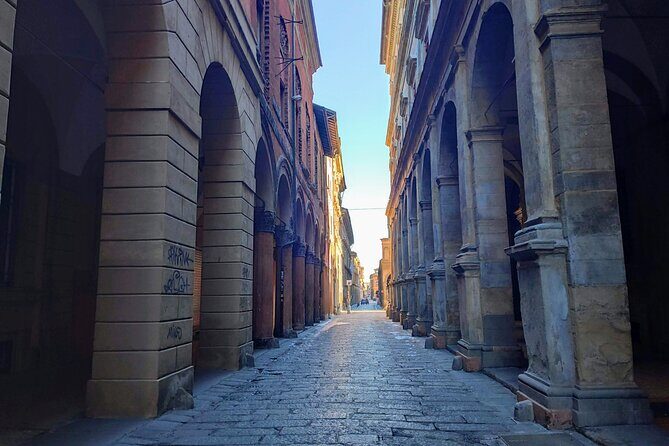
Next up is Piazza VIII Agosto, where something lively happens on Friday and Saturday: the traditional “Piazzola market,” with over 400 street stalls.
Even if you’re not there on a market day, the square’s role in daily Bologna life makes it a strong puzzle backdrop. The app pushes you to scan the area for a challenge answer and tie it back to the story of the place.
This stop is where the quest can feel most “lived in.” Bologna can be busy even without a market, but on market days you’ll want to pace yourself and keep your eyes up—crowds can make it easier to miss small clue details.
Arena del Sole: theatre history in an “1810 roots, 1995 revival” stop
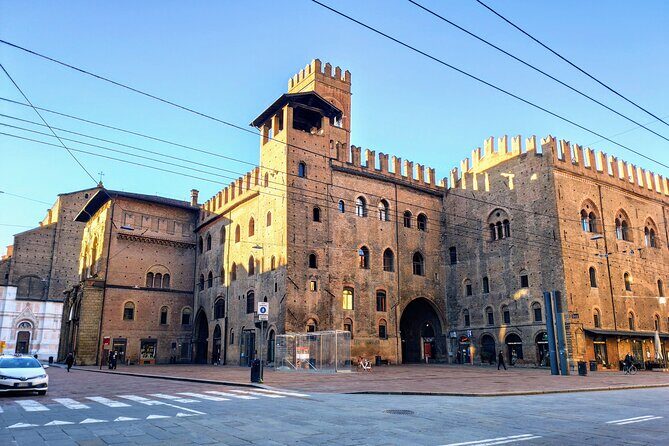
Your route includes the Arena del Sole, a historic theatre with origins dating to 1810. It was reopened in 1995 after an eight-year reconstruction.
I like theatre sites on city quests because they offer a clean contrast: you can be walking in daylight and still feel the building’s long performance memory. Here, the clue activity is a gentle nudge to pay attention to the theatre’s place in the city’s culture—not just its façade.
Because this is still a working city, not a staged attraction, the most important thing is to look around at what you can see and follow the app instructions. If the area is busy or entrances aren’t obvious, take your time. That’s part of the game.
Other guided tours in Bologna

Fountain of Neptune: bronze details and Renaissance design hints
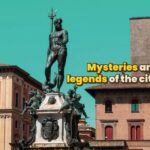
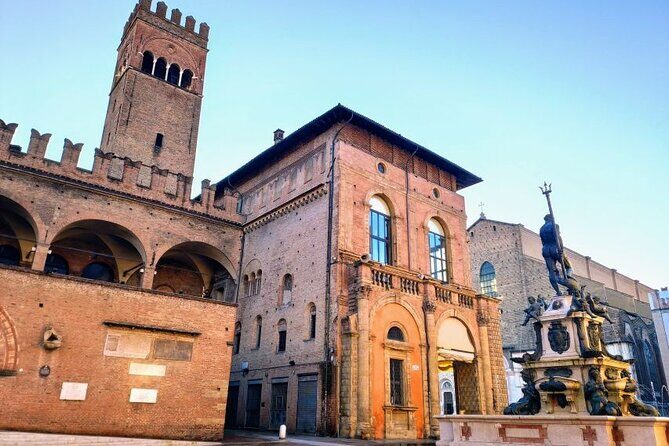
Then you hit one of Bologna’s most famous visual points: the Fountain of Neptune. The fountain was completed in 1565, and the over-life-size bronze Neptune figure was completed and fixed in place around 1567.
The clue theme here is tied to authorship and artistic history. The Neptune statue was an early design by Giambologna, who had submitted a model for the Fountain of Neptune in Florence but lost the commission to Baccio Bandinelli.
This stop is ideal if you like “wait, who made that?” moments. The app’s challenge format means you’ll look at the statue’s context rather than treating it like a quick photo stop. You’re basically practicing how to read art in public spaces.
One small practical note: fountains and open squares can get crowded. If you don’t like shoulder-to-shoulder sightseeing, choose a quieter time window and be patient while you scan for clue answers.
Oratory built in the late 1400s: looking under the surface
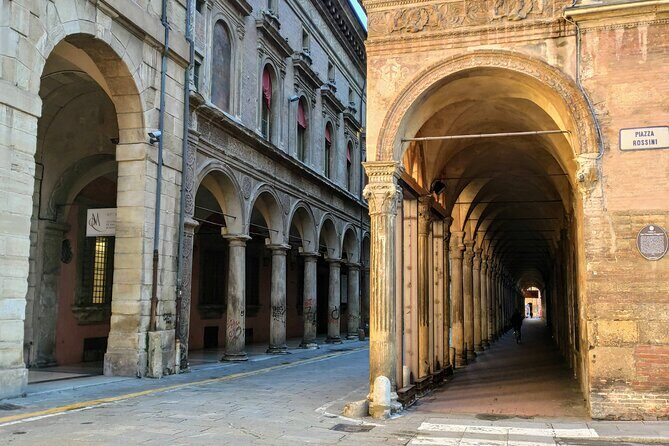
You’ll also be directed to an oratory built between 1481 and 1497. It was developed by the celestine fathers of the nearby church of San Giovanni Battista, in an area below which there was structure from an early medieval city wall door. An ancient image of the Madonna was protected by a simple tabernacle.
This is one of those Bologna stops that rewards curiosity. The key detail isn’t a big headline; it’s the layering—walls, religious tradition, and older traces beneath later religious spaces.
The app’s “look around and find the answer” approach works especially well here. It encourages you to notice what’s visible right now, while the historical facts give you a way to interpret the setting.
If you like quiet corners and you don’t mind short pauses to look closely, you’ll probably enjoy this part of the route.
Piazza Maggiore and San Petronio: the unfinished facade puzzle
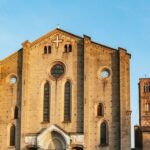
At Piazza Maggiore, you face San Petronio, the basilica dedicated to Bologna’s patron saint, Saint Petronius, bishop of Bologna in the fifth century. Construction began in 1390, but the main facade has remained unfinished since.
This combination—major central square plus an unfinished grand plan—is very Bologna. It’s not the kind of monument where everything feels completed and tidy. Instead, it tells you a story about time, ambition, and stopping points.
As with the other challenges, you’ll be asked to search around to find the answer that advances you. That format is smart here because San Petronio is visually complex. A quick pass won’t teach you much. Slow scanning will.
If your travel style is “I want one big landmark and then I’m done,” this might feel like a lot. If you enjoy monuments as puzzles, it’s a highlight.
Baroque church with Sorrow over Dead Christ: art you can’t ignore
Your route continues to a Baroque church where construction began in 1687 to 1690, designed by Giovanni Battista Bergonzoni. The church uses an elliptical plan with a dome designed by Giuseppe Tubertini, completed in 1787. The facade wasn’t added until 1905.
The sanctuary houses a sculptural group called Sorrow over Dead Christ (1463) by Niccolò dell’Arca.
This stop is the one where the quest can feel more emotional than “just facts.” The title alone sounds heavy, and the app challenge helps you notice what you’re looking at instead of rushing past.
The building’s timeline also gives you a handy mental map: Baroque structure, later facade, and a mid-1400s sculpture inside. It’s the kind of layering that makes Bologna more interesting than any one period.
If you’re sensitive to dramatic religious art, just know this is part of the experience. The good news: the self-guided format gives you control over how long you stay.
Two leaning towers: Asinelli and Garisenda challenges
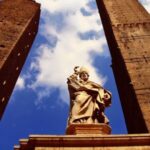
Next comes a classic Bologna pairing: the towers. The taller one is Asinelli, and the smaller but more leaning one is Garisenda. Their names come from families traditionally credited with building them between 1109 and 1119.
This area is perfect for a puzzle format because it’s visually unmistakable. You can spot the towers quickly, then use the app prompts to focus on details you might not normally notice—like scale, alignment, and how the towers sit in the streetscape.
The biggest practical consideration here is crowd flow. The towers are famous for a reason, and people gather. If you want to solve calmly, aim for less peak times.
University of Bologna area: classes once held anywhere
Your quest route includes a stop tied to the University of Bologna, described as the oldest university in Europe. The key clue idea here is that the university didn’t have a base until well into the Renaissance. Before that, classes happened in professors’ homes or in public spaces like the one you’re standing near.
That changes the way you think about the city. Bologna isn’t just a place with a university campus; it’s a city where learning once plugged directly into everyday streets.
With an app-based clue, you’re encouraged to look at the specific public space around you and connect it to the idea of early classes happening outdoors or in homes. It’s a good reminder that education isn’t always one fixed building.
If you like understanding how cities worked day to day, this stop will land well. It’s also one of the more “mind-expanding” parts of the route without requiring a long sit-down.
Montagnola Park, Cathedral area, and a slower walk rhythm
The route then swings through Parco di Montagnola, a public park in Bologna. It owes its original construction in 1805 to Napoleonic rule, which commissioned the park design from Giovanni Battista Martinetti.
Parks are useful in a quest like this because they create breathing room. You’re solving puzzles while walking, so a green space helps you catch your stride.
After the park, you’ll reach Bologna Cathedral, dedicated to Saint Peter. It serves as the seat and metropolitan cathedral of the Archbishop of Bologna. Most of the present building dates from the 17th century, with a few parts from the late 16th century.
Even without a long guided explanation, the combo works well: park pause, then a shift back into religious architecture. The app’s “look around” style keeps you alert without pushing you to read a screen nonstop.
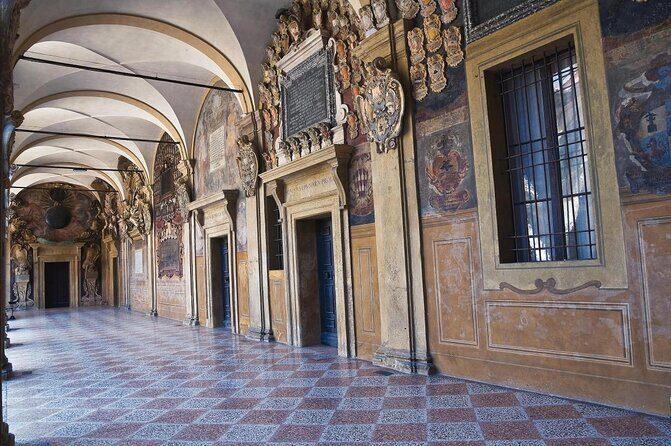
Archiginnasio and Palazzo dei Banchi: learning in buildings and facades
Near the end of your quest, you’ll encounter two major Bologna addresses tied to education and public commerce.
First is Archiginnasio, the Schools building named after the classical term used for the Studium, Bologna’s original university name. Construction began in February 1562 and was built very quickly, inaugurated on October 21, 1563.
Then comes Palazzo dei Banchi, the last building erected in Piazza Maggiore. It was designed by Vignola in the 16th century. Its spectacular façade was intended to hide the alleys of the rear market, and the name comes from ancient currency exchange “banks.”
These are excellent finale stops because they answer the question you’ll be carrying all along: why did Bologna build the way it did? Facades hiding markets, a university building that went up quickly, and public spaces that shaped how people worked and learned.
Also, by the time you reach these, you’ve already trained your eyes on “find the answer here” details. So your final puzzles can feel smoother and more satisfying.
How to make the quest feel easy (instead of stressful)
I suggest you treat this like an hour-long scavenger hunt, not like a sprint. Here are a few ways to keep it fun:
- Start when you have steady walking time, since the route is designed for foot travel.
- If you feel lost, slow down and re-check the app instructions. The format is built around moving from one clue point to the next.
- Expect that the story is a framework for getting you to pay attention. If you’re chasing perfect whodunit logic, you might feel less satisfied. If you’re chasing cool city details, you’ll be happy.
And yes—because it’s self-guided, you can wander off course if you take side streets. That’s not a deal-breaker. It just means you should keep your phone handy and let the app bring you back.
Should you book the Bologna Murder Mystery quest?
Book it if you want a low-cost, high-attention way to see Bologna’s big landmarks and also its quieter corners. For families and groups of friends, the puzzle format can be a great way to get everyone engaged, and you’ll be walking past more than the usual top-photo sites.
Skip it if you strongly prefer a live guide telling you exactly what to notice, or if you want a mystery plot with airtight logic. This is about city reading through clues. If that sounds like your style, it’s a smart use of time.
FAQ
How long is the Bologna Murder Mystery self-guided city quest?
It takes about 1 hour.
What does it cost?
It’s priced at $6.00 per person.
Do I need an internet connection to play?
No. The game is designed to work without an internet connection, so you won’t use up your data.
Is it available in English?
Yes, it’s offered in English.
Can I start and stop whenever I want?
Yes. It’s independent, and you can choose your beginning and end time. You can also pause and resume anytime.
What’s included with the booking?
You get a mobile access code, 11 puzzle challenges, an interactive mystery storyline with real-world clues, and the ability to pause/resume.
Where do I meet, and where does it end?
Start: P.za XX Settembre, 15, 40121 Bologna BO, Italy. End: P.za Rossini, 1, 40126 Bologna BO, Italy. The app provides step-by-step directions to reach Piazza Rossini.
Is there a physical tour guide with you?
No. A physical tour guide is not included.
Can I cancel for free?
Yes. You can cancel for free up to 24 hours in advance for a full refund.