REVIEW · BOLOGNA
Discover Bologna an amazing city
Book on Viator →Operated by Alliet’ARTI Tours - Manuela Roversi · Bookable on Viator
Bologna clicks fast in three hours. I love the private format for skipping the crush, and I love how Manuela Roversi brings each site to life with stories from a long-time Bologna life. One thing to plan for: a dress code is required in churches, and you can be refused entry if you ignore it.
This is a tight, 3-hour intro built for first-timers. You get an English guide, a group limited to up to 10, and a walk through the center that lines up major monuments without wasting time.
It also helps if you’re the type who likes seeing the “everyday” Bologna alongside the big landmarks. Most stops here are free to access, but some sights have conditions and the tour does not include tickets or food, so you’ll want to budget a little for any add-ons.
In This Review
- Key things that make this tour worth your time
- Why Bologna feels different, and how this tour helps
- Price and value: what $125.10 per group buys you
- Timing, start/end points, and how the walking fits a short visit
- Piazza Maggiore: the civic center you’ll want to remember
- Neptune Fountain and the trident detail that locals never forget
- San Petronio: Charles V, the Council of Trent, and a sundial you can see
- Via Rizzoli and the Roman axis: how to read the city’s street plan
- Quadrilatero: Bologna’s La Grassa food-market world in mini-format
- Archiginnasio: education made visible through heraldry
- Piazza Santo Stefano and the Seven Churches complex
- Strada Maggiore and Casa Isolani: arcades where wood does the talking
- The Two Towers: Bologna’s leaning icons at the finish line
- Who this tour suits (and who should look elsewhere)
- Should you book this private Bologna intro tour?
- FAQ
- How long is the tour?
- Is this a private tour, and what group size is it?
- What language is the tour offered in?
- Are tickets or food included?
- Is there a dress code for visiting places of worship?
- What if I want to add the old anatomy theatre?
Key things that make this tour worth your time
- Manuela Roversi’s local storytelling: she keeps the city moving with clear, human explanations
- Private pace (up to 10): you can ask questions and not get swept along
- A smart route in ~3 hours: Piazza Maggiore to the Two Towers without backtracking
- Food culture stops: you’ll see the Quadrilatero area tied to Bologna’s La Grassa reputation
- Church context with practical guidance: including the dress-code reality before you step inside
- Optional anatomy theatre: only if you want it, with an extra fee you pay on the day
Why Bologna feels different, and how this tour helps
Bologna sits between Venice and Florence, and it earns its place as a major rail hub and an international-airport city. That location matters because it makes a side trip here easy, even if your main plan is elsewhere.
Where Bologna wins is that it feels like a working Italian city, not a theme park. This tour is designed to help you get that feeling fast by focusing on the places locals actually use, plus monuments that explain why Bologna became Bologna.
If you’ve only got half a day, this works because the route is structured. You’re not bouncing around randomly; you’re following the main threads of the city—civic life, education, church power, and street-level food culture—while staying in one walkable area.
Other city tours we've reviewed in Bologna
Price and value: what $125.10 per group buys you
The price is $125.10 per group (up to 10) for about 3 hours. That means you’re not paying per person—you’re paying for a private guide and a plan that doesn’t depend on the speed of a big tour group.
Here’s the useful way to think about it: if you share it with a few people, the cost per person drops quickly. If you’re a solo traveler, you’ll pay the full group rate, but you still get the private benefit and focused attention.
You also get a professional guide and a qualified local tour guide included. That matters in Bologna because the city rewards context—why a building looks a certain way, why a square was laid out the way it was, and how power shifted over centuries.
Timing, start/end points, and how the walking fits a short visit
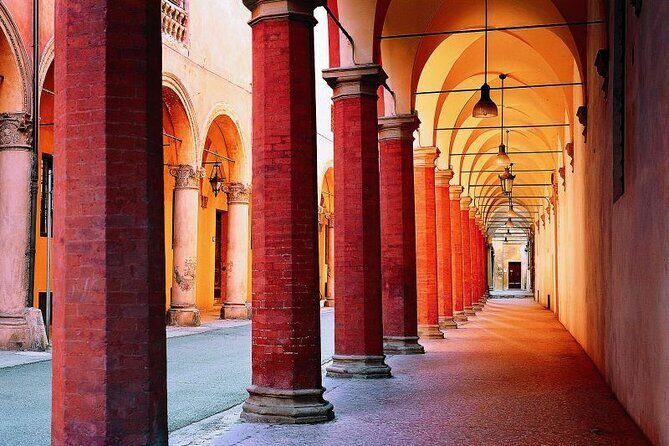
The tour runs about 3 hours and is in English. You start at Piazza Maggiore, 1/e, 40124 Bologna and finish near Torre della Garisenda at Piazza di Porta Ravegnana.
That start-to-finish line is convenient because it puts you in the heart of the historic center from the first minute. You’ll spend your time where you want to be anyway—squares, arcades, churches, and the street corridors that connect everything.
Transportation to/from attractions is not included, which tells you something important: expect a walking itinerary. Wear shoes you’d happily walk in for a few hours, not just a casual stroll.
Piazza Maggiore: the civic center you’ll want to remember
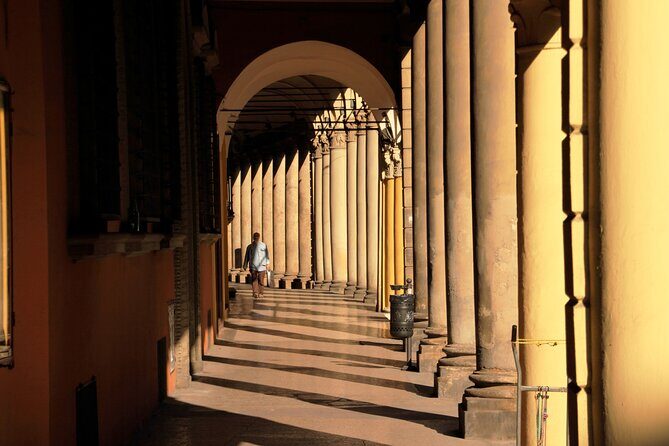
Piazza Maggiore is Bologna’s historic centerpiece going back to Roman times. The square is surrounded by major landmarks, and the guide’s job is to help you see how they relate to each other instead of treating them like separate photo stops.
You’ll take in the Neptune fountain area, the Basilica of San Petronio, the old town halls, and other classic civic buildings around the square. It’s a lot visually, but it’s also the right place to start because it sets the tone: this city has always been about public life.
One practical note: the square is free, but it can feel busy around peak hours. The private format helps you keep your momentum and not spend the best parts of your tour stuck in foot traffic.
Neptune Fountain and the trident detail that locals never forget
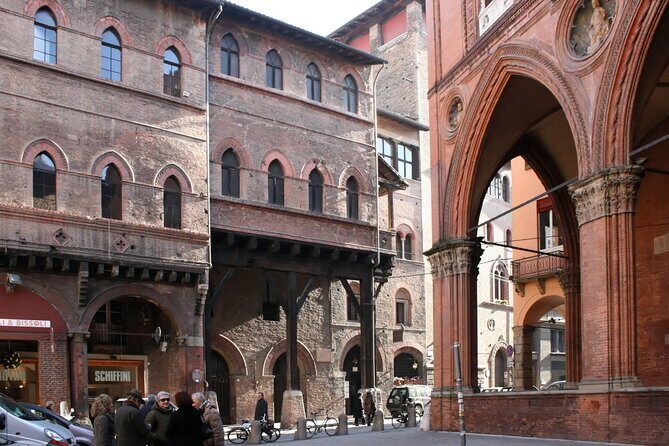
The Fontana del Nettuno (Neptune Fountain) is a monumental civic fountain in Piazza del Nettuno. It’s a model of Mannerist taste from the mid-1500s, which means the styling is more courtly and theatrical than plain and functional.
Then there’s the fun detail that makes the fountain stick in your head: the trident used by the Maserati brothers became the emblem for their first car, and it still lives on in the Maserati logo. This is exactly the kind of cross-reference a good local guide makes easy to remember.
Stop time here is short, but that’s fine. You’re not rushing through; you’re learning what to notice before you walk away.

San Petronio: Charles V, the Council of Trent, and a sundial you can see
Basilica di San Petronio is huge, and it’s famous for events tied to the political and religious power shifts of the 1500s. One major moment: Charles V became the last Holy Roman Emperor to be crowned by a pope in 1530.
You’ll also hear about a section of the Council of Trent, tied to the Counter-Reformation. It’s not the kind of detail you’d pick up just by staring at the façade, so the guide really earns the time here.
The other highlight is technical and quietly impressive: there’s a meridian line inlaid in the left aisle paving, marked in 1655. It’s described as the longest covered sundial in the world, and seeing the idea in place makes the science feel human, not museum-abstract.
Dress code is required for churches, and you can risk being refused entry if you don’t comply. I’d rather you be over-prepared than forced to watch from the doorway.
Via Rizzoli and the Roman axis: how to read the city’s street plan
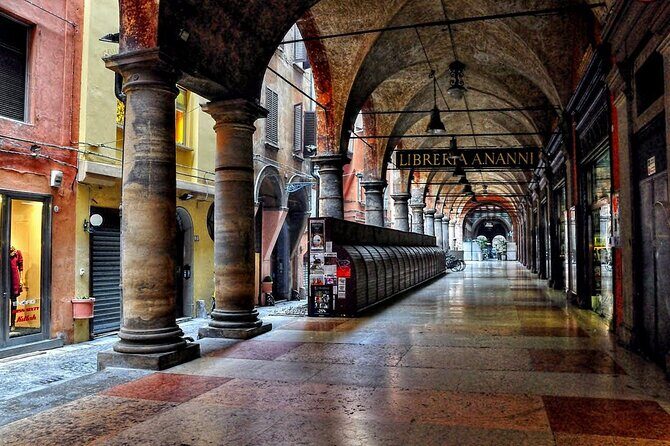
Via Rizzoli, paired with Via Ugo Bassi, follows the route of Bologna’s main Roman axis. The Roman Via Emilia is noted as being built in the 2nd century B.C., which helps you understand why certain streets feel straight, structural, and built to connect power points.
This part of the walk sets up the city’s most famous silhouette. From Via Rizzoli, you can see the two leaning towers that became Bologna’s symbol.
If you like cities that have a legible “plan,” this is a good moment. The guide points out what looks medieval but has Roman geometry under it, which makes your later photos and observations feel less random.
Quadrilatero: Bologna’s La Grassa food-market world in mini-format
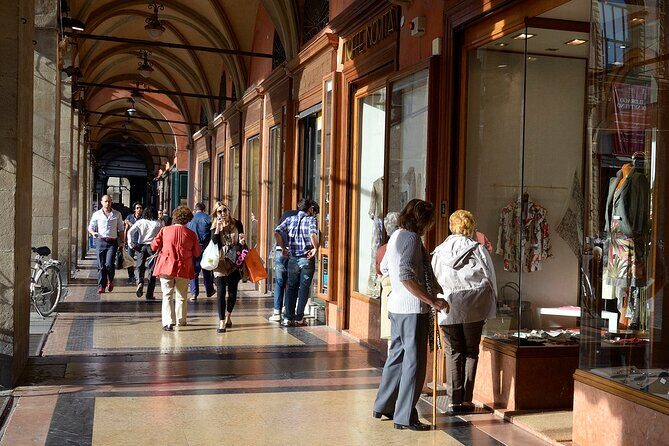
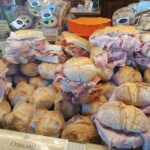
Bologna has a famous food identity, locally known as La Grassa (the fat one). The Quadrilatero is where you feel that identity in real street form: a food market area with narrow medieval-style passages and packed vendors and old-school stalls.
What makes this stop work on a short intro is the contrast. You’ll see the monumental power sites first, then you get hit with the day-to-day energy of food commerce right in the middle of the historic center.
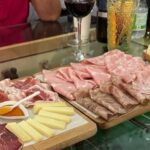
There’s no requirement that you eat during the tour, but food is part of the atmosphere. Just remember: tickets, food, and drinks are not included, so treat any tastings as optional add-ons you choose on the day.
Archiginnasio: education made visible through heraldry
Archiginnasio di Bologna is the kind of building that rewards even a short stop if you care about how cities think. Its purpose was to create a unit seat for university teaching that had been dispersed in different places.
The decorations are described as the biggest existing heraldic wall complex. That means you’re not only looking at architecture—you’re looking at identity, affiliations, and how institutions showed off status.
On request, you can also visit the old anatomy theatre. Entrance is an extra €3.00 per person, paid directly on tour date, so you’ll only add it if you want more detail. If your group enjoys buildings with function and history, this can be a great upgrade.
Piazza Santo Stefano and the Seven Churches complex
Piazza Santo Stefano is also known as Piazza delle Sette Chiese, the Seven Churches square. The whole area is pedestrian-friendly and known for events like cultural happenings, flea-markets, and concerts, with porticos along the long sides.
The attached basilica complex is locally known as Seven Churches and Holy Jerusalem. It includes multiple churches from different periods, including the Church of Saint Stephen (8th century) and the Church of the Holy Sepulchre (5th century), rebuilt on a Roman temple.
Other named parts include the Church of Saints Vitale and Agricola (5th century, rebuilt in the 12th century), the Courtyard of Pilate, and the Church of the Trinity or of the Martyrium (13th century). It’s a lot to absorb, so the value of a guide is turning a cluster of structures into a story you can follow.
There’s also a timing warning that can affect your day: the complex is closed on Mondays. If your trip lands on a Monday, plan your expectations accordingly and let the guide know your priority.
Strada Maggiore and Casa Isolani: arcades where wood does the talking
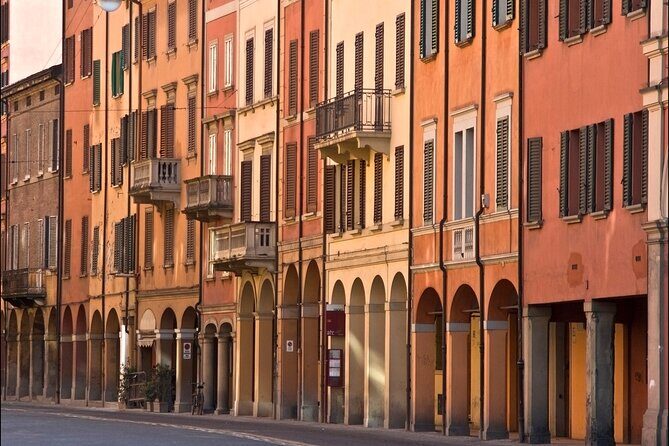
Strada Maggiore sits between Piazza Santo Stefano and the Isolani complex, connected by a gallery linking the two places. You’ll see different architectural “faces”: one side reads as a medieval house with Romanesque-Gothic elements, while the other side looks more like a Renaissance senatorial palace.
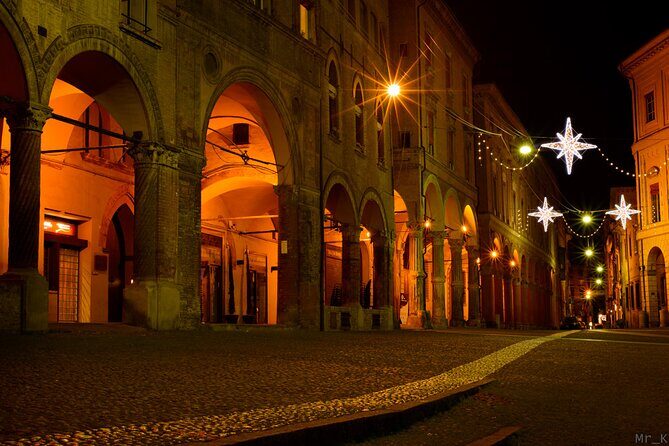
The Casa Isolani arcade is called out as one of the most evocative Bolognese arcades, and for a good reason. The wooden portico is described as the highest in the city, with oak beams about 9 meters high supporting a third floor that began as a middle-ages civil dwelling.
This is one of those spots where a quick explanation changes what you notice. Instead of seeing a pretty walkway, you start noticing construction logic, height, and why Bologna’s covered streets feel so distinct.
The Two Towers: Bologna’s leaning icons at the finish line
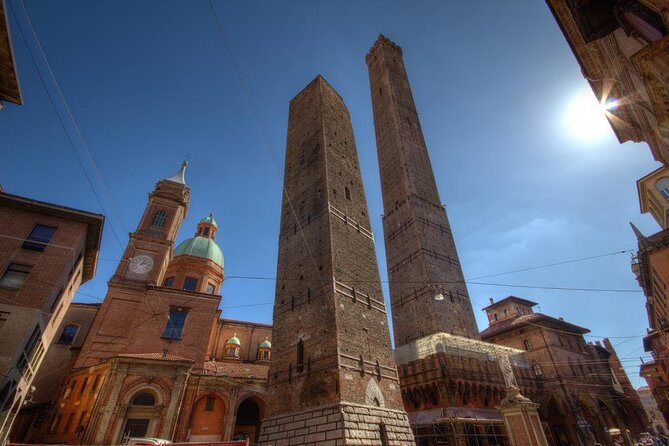
You’ll end near the Two Towers: Torre degli Asinell i and Torre Garisenda. These are Bologna’s most prominent leaning towers and the symbol you’ll keep seeing in postcards, but the in-person effect is bigger.
They’re located at the intersection of roads leading to five gates of the old ring wall. Their names come from the families who built them between 1109 and 1119, which gives the towers a sharper human origin than just a skyline feature.
The tour’s finish here is smart because you can keep exploring on your own right after—cafés, photo angles, and nearby streets all become easier when you end at the city’s visual anchor.
Who this tour suits (and who should look elsewhere)
This private Bologna intro fits best if you’re:
- visiting Bologna for the first time and want major sights in a short window
- the type who likes architecture and city layout, not only museum interiors
- traveling with a small group that wants control over pace and questions
- food-minded but still wants context around what you’re seeing in the market areas
It may not fit perfectly if your priority is ticket-heavy attractions or if you dislike religious sites and dress-code requirements. The itinerary includes churches, and while entry to key areas is free, compliance matters.
It also helps if you’re flexible on “inside” time. Some places are structured as outward viewing and context rather than long museum stays, and that’s intentional for a 3-hour overview.
Should you book this private Bologna intro tour?
I’d book it if you want a first-timer plan that doesn’t feel like a conveyor belt. The biggest strength is the guide—Manuela Roversi—who clearly knows how to connect details to the bigger Bologna story, and the private format keeps the experience calm and interactive.
It’s also a good value because the price is per group and the route hits multiple major monuments, plus food-market culture, all in about half a day. Add in the free-to-access stops and you get a lot of orientation for your time.
Just go in with two practical realities: plan for dress code at churches, and remember the Santo Stefano complex is closed on Mondays. If you can handle those, this tour gives you the kind of Bologna understanding that makes the rest of your trip feel easier.
FAQ
How long is the tour?
The tour lasts about 3 hours.
Is this a private tour, and what group size is it?
Yes, it’s a private tour/activity, and it’s priced for up to 10 people in your group.
What language is the tour offered in?
The tour is offered in English.
Are tickets or food included?
No. Tickets, food, and drinks are not included.
Is there a dress code for visiting places of worship?
Yes. A dress code is required to enter places of worship, and you may be refused entry if you don’t comply.
What if I want to add the old anatomy theatre?
The old anatomy theatre can be added on request. The entrance fee is €3.00 per person, paid directly on the tour date.